🎯 Introduction

A large share ofcritical tactical gear is now
electronic and runs on batteries or battery packs: red dots, optronics, flashlights, weapon lights, IR signaling beacons, radios, GPSWhether you’re military, a gendarme, a police officer , or an enthusiast, power management in the field has become a key factor in operational self-sufficiency.
In this article, we will review all the power supply levels that matter to the end user in the field, from the simple CR123A rechargeable battery all the way to the solar panel — to help you achieve optimal energy self-sufficiency on missions or on the move.
⚠️ The Problem with Magnetic Charging Devices
To address the issues of frequent battery changes and the associated costs, brands of varying quality have started introducing charging systems using proprietary magnetic connectors.
But these devices pose several concrete problems in the field:
❌ They require proprietary cables , while the vast majority of tactical accessories use AA / AAA / CR123A batteries, and the universal standard — even for Apple since 2025 — isUSB-C.
❌ Accessories have to be removed from the weapon or helmet to be recharged.
❌ They are unusable for the entire time they are charging, which is not acceptable in an operational context.
💰 The Real Cost of Batteries for Our Tactical Gear
Accessories such as tactical lights, aiming lasers , or night vision devices are mostly powered by disposable batteries. The cost of good-quality CR123A batteries is significant, and it’s hard to quickly check a battery’s charge level in the field. That’s why we

turned to USB-C rechargeable batteries.
📊 Cost comparison:
ASP CR123 batteries — very good quality — cost €5.50 each. A high-quality rechargeable CR123A (Pale Blue brand) costs €9.98 each excluding promotions.
✅ This means thatby the second charge of a Pale Blue rechargeable battery, , you’re already ahead compared to buying regular batteries. Especially since this kind of battery can be recharged about 1,000 times… I’ll let you do the math!
🔋 Our Tactical Charging Pyramid

In the rest of this article, we will cover all the levelsof power supply that matter to end users
in the field. These different levels fit together and complement each otherto achieveenergy self-sufficiency.
We have represented it as follows:
🔹 Level 1 — Rechargeable batteries (CR123A, AA, AAA) that go inside the devices.
🔹 Level 2 — Power banks to recharge batteries and devices with built-in batteries.
🔹 Level 3 — Portable power stations to recharge the power banks.
🔹 Level 4 — Solar panels to recharge the power stations.
🔋 Level 1: USB-C Rechargeable CR123A / AA / AAA Batteries
 Originally, I wasn’t a fan of rechargeable batteries back when you needed a proprietary charger plugged into a wall outlet.
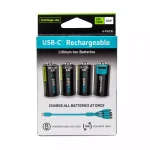
The Pale Blue rechargeable batteries, on the other hand, charge via a USB-C cable that plugs directly into the battery (octopus cable included), which provides great logistical resilience and lets you recharge them even on the move from a power bank or a solar panel.
⚠️ Important point for night vision users: unlike most CR123A rechargeable batteries, which have a voltage above 3.0 V, Pale Blue batteries have the same voltage as an alkaline battery = 3.0 V with constant-voltage discharge, which makes them usable in night vision devices without worrying about your image intensifier tubes.
I wanted to switch to rechargeable batteries a long time ago for everyday devices — remote controls, computer mice — but the voltages were inconsistent and the charging port was micro USB instead of USB-C. Using these batteries in tactical accessories was only made possible for me by the quality of Pale Blue rechargeable batteries.
🧠 About Pale Blue: it’s a French-American brand that focuses on making high-quality rechargeable batteries with a USB-C port to replace single-use batteries, with a sustainable and operational approach.
⚡ Level 2: Power Banks
Not all power banks are created equal. And it was only after buying and using more than twenty power banks of various models over the past decade that I truly understood the key criteria for EDC and field use.
📏 Maximum Capacity and Air Travel
If you carry your power banks on a plane, you need to pay attention to the maximum allowed capacity. To be accepted in the cabin, power banks must not exceed 100 Wh (about 27,000 mAh at 3.7 V). This is usually stated in the description of the power bank you order.

🔌 Power Output
To charge your devices quickly or power a phone, a rugged tablet, or a laptop, you’ll need a high minimum power output. I consider 65 W per port to be a comfortable figure for an “all-purpose portable power bank.”
⚠️ Watch out for marketing specs: for example, my favorite 25 Ah MoveSpeed power bank is advertised as a 130 W power bank. But that figure is the maximum total output. Looking at the spec sheet, the USB-C ports deliver a maximum of 100 W each when used alone. However, if both USB-C ports are used at the same time, the maximum output is 65 W per port (65 + 65 = 130 W total). It still delivers at least 65 W even when both ports are in use, which is still excellent.
🔄 Power Bank Charging Input
A high-capacity power bank is only worthwhile if you can recharge it quickly. Low-quality power banks often have a charging input far below their maximum output. On the MoveSpeed power banks I use every day, the charging input is 65 W, which allows fast, efficient recharging of the power bank (nothing worse than waiting 24 hours to recharge a portable battery).
🛡️ Beware of “Rugged” Power Banks
I want to draw your attention to rugged / waterproof power banks , because ruggedness often comes with reduced power. Check the specs carefully before buying! Personally, I prefer to put high-performance power banks in dry bags or zip-top bags — it’s lighter, more powerful, and just as tough in practice.
📦 Compact Power Banks (Daily EDC)
Here is the model I’ve been using every day for several years now. It meets 100% of my criteria: light, tough, reliable, with high output and charging power. I own 4 that I rotate, and I’ve tested them with a wide range of devices — from the iPhone to the DELL Latitude 7212 rugged tablet , and rechargeable batteries too. A new version has since come out:
🔗 MoveSpeed Compact 140 W Power Bank – 25,000 mAh
For a few months now, I’ve also been using the SP Connect 10 Ah rugged power bank , which can charge by wireless induction (10 W) and by cable (40 W fast charging) with a good-quality mini cable included. An excellent mid-capacity power bank that slips into your pocket.
🔗 SP-Connect Ultra-Compact Rugged MagSafe Power Bank 40/10 W – 10,000 mAh
📦 Semi-Compact Power Banks (Bivouac / Forward Post)
I own a second higher-capacity power bank model: 70 Ah. It’s heavier and you won’t be able to take it on a plane. It’s useful for powering several devices for a long time from the bottom of a pack, or set down at a bivouac or forward post.
I particularly like this one because it’s one of the few power banks of this capacity (70,000 mAh) with high output and charging power — high-capacity power banks often compromise on charging power, but not this one.
🔗 MoveSpeed Semi-Compact 140 W Power Bank – 70,000 mAh
🏕️ Level 3: The Portable Power Station
For extended “off-the-grid” stays — with no grid connection or electricity — you’ll need to be able to recharge your power banks or plug in devices with a 220 V plug.
For that, we use Bluetti power stations and in particular the AC200 V2 model, which offers the best energy-to-size ratio for field use.

They’re “tanks,” but theruntime is HUGE and it features:
✅ 2 × 220 V outlets (AC or DC) to power any type of device
✅ USB-C and standard USB ports for maximum flexibility
✅ Charging from a wall outlet, a cigarette lighter socket, or solar panels
✅ UPS function for backup power use
✅ App control via Bluetooth or Wi-Fi
The Bluetti AC200 V2 power station is a true silent generator that is just as well suited to a forward command post as to an extended bivouac.
☀️ Level 4: Solar Panels — Total Energy Self-Sufficiency
This is the final power level for achieving near-infinite energy self-sufficiency in the field.
With latest-generation solar panels, efficiency has improved significantly, and you can connect them to a power station to keep it charging continuously — even in poor weather.
Personally, we haven’t been able to test a model yet, but we plan to order the Pale Blue solar panels , which appear to offer the best compromise in terms of size / power for tactical use. A dedicated article will follow after our field tests.
🧩 Conclusion
The management of your power supply is an often underestimated topic when preparing for a mission or deployment. Yet a red dot without a battery, a dead radio, or a light that won’t turn on can have major consequences.
By structuring your power supply into 4 complementary levels — rechargeable batteries, EDC power banks, a portable power station, and solar panels — you give yourself the means to stay operational in all circumstances, whether for an intervention lasting a few hours or an extended off-grid deployment.
🔹 Find our rechargeable batteries and power accessories in the Hexatac shop.
Disclaimer:
Pale Blue products were sent to us for testing at our request, after we had known the brand for several years.
MoveSpeed products were purchased personally and have been used for several years.
The Bluetti power station was sent to us free of charge, at our request, for evaluation and for writing this article.
Note: some links in this article may be affiliate links. Using them in no way influences our selection or recommendations.
Tags: tactical gear power supply, USB-C CR123A rechargeable batteries, EDC field power bank, military and law enforcement energy autonomy, night vision rechargeable battery, tactical portable power station, operational field solar panel, tactical device power management, Pale Blue CR123A, high-power power bank
A large share ofcritical tactical gear is now
electronic and runs on batteries or battery packs: red dots, optronics, flashlights, weapon lights, IR signaling beacons, radios, GPSWhether you’re military, a gendarme, a police officer , or an enthusiast, power management in the field has become a key factor in operational self-sufficiency.
In this article, we will review all the power supply levels that matter to the end user in the field, from the simple CR123A rechargeable battery all the way to the solar panel — to help you achieve optimal energy self-sufficiency on missions or on the move.
⚠️ The Problem with Magnetic Charging Devices
To address the issues of frequent battery changes and the associated costs, brands of varying quality have started introducing charging systems using proprietary magnetic connectors.
But these devices pose several concrete problems in the field:
❌ They require proprietary cables , while the vast majority of tactical accessories use AA / AAA / CR123A batteries, and the universal standard — even for Apple since 2025 — isUSB-C.
❌ Accessories have to be removed from the weapon or helmet to be recharged.
❌ They are unusable for the entire time they are charging, which is not acceptable in an operational context.
💰 The Real Cost of Batteries for Our Tactical Gear
Accessories such as tactical lights, aiming lasers , or night vision devices are mostly powered by disposable batteries. The cost of good-quality CR123A batteries is significant, and it’s hard to quickly check a battery’s charge level in the field. That’s why we
turned to USB-C rechargeable batteries.
📊 Cost comparison:
ASP CR123 batteries — very good quality — cost €5.50 each. A high-quality rechargeable CR123A (Pale Blue brand) costs €9.98 each excluding promotions.
✅ This means thatby the second charge of a Pale Blue rechargeable battery, , you’re already ahead compared to buying regular batteries. Especially since this kind of battery can be recharged about 1,000 times… I’ll let you do the math!
🔋 Our Tactical Charging Pyramid
In the rest of this article, we will cover all the levelsof power supply that matter to end users
in the field. These different levels fit together and complement each otherto achieveenergy self-sufficiency.
We have represented it as follows:
🔹 Level 1 — Rechargeable batteries (CR123A, AA, AAA) that go inside the devices.
🔹 Level 2 — Power banks to recharge batteries and devices with built-in batteries.
🔹 Level 3 — Portable power stations to recharge the power banks.
🔹 Level 4 — Solar panels to recharge the power stations.
🔋 Level 1: USB-C Rechargeable CR123A / AA / AAA Batteries
Originally, I wasn’t a fan of rechargeable batteries back when you needed a proprietary charger plugged into a wall outlet.
The Pale Blue rechargeable batteries, on the other hand, charge via a USB-C cable that plugs directly into the battery (octopus cable included), which provides great logistical resilience and lets you recharge them even on the move from a power bank or a solar panel.
⚠️ Important point for night vision users: unlike most CR123A rechargeable batteries, which have a voltage above 3.0 V, Pale Blue batteries have the same voltage as an alkaline battery = 3.0 V with constant-voltage discharge, which makes them usable in night vision devices without worrying about your image intensifier tubes.
I wanted to switch to rechargeable batteries a long time ago for everyday devices — remote controls, computer mice — but the voltages were inconsistent and the charging port was micro USB instead of USB-C. Using these batteries in tactical accessories was only made possible for me by the quality of Pale Blue rechargeable batteries.
🧠 About Pale Blue: it’s a French-American brand that focuses on making high-quality rechargeable batteries with a USB-C port to replace single-use batteries, with a sustainable and operational approach.
⚡ Level 2: Power Banks
Not all power banks are created equal. And it was only after buying and using more than twenty power banks of various models over the past decade that I truly understood the key criteria for EDC and field use.
📏 Maximum Capacity and Air Travel
If you carry your power banks on a plane, you need to pay attention to the maximum allowed capacity. To be accepted in the cabin, power banks must not exceed 100 Wh (about 27,000 mAh at 3.7 V). This is usually stated in the description of the power bank you order.
🔌 Power Output
To charge your devices quickly or power a phone, a rugged tablet, or a laptop, you’ll need a high minimum power output. I consider 65 W per port to be a comfortable figure for an “all-purpose portable power bank.”
⚠️ Watch out for marketing specs: for example, my favorite 25 Ah MoveSpeed power bank is advertised as a 130 W power bank. But that figure is the maximum total output. Looking at the spec sheet, the USB-C ports deliver a maximum of 100 W each when used alone. However, if both USB-C ports are used at the same time, the maximum output is 65 W per port (65 + 65 = 130 W total). It still delivers at least 65 W even when both ports are in use, which is still excellent.
🔄 Power Bank Charging Input
A high-capacity power bank is only worthwhile if you can recharge it quickly. Low-quality power banks often have a charging input far below their maximum output. On the MoveSpeed power banks I use every day, the charging input is 65 W, which allows fast, efficient recharging of the power bank (nothing worse than waiting 24 hours to recharge a portable battery).
🛡️ Beware of “Rugged” Power Banks
I want to draw your attention to rugged / waterproof power banks , because ruggedness often comes with reduced power. Check the specs carefully before buying! Personally, I prefer to put high-performance power banks in dry bags or zip-top bags — it’s lighter, more powerful, and just as tough in practice.
📦 Compact Power Banks (Daily EDC)
Here is the model I’ve been using every day for several years now. It meets 100% of my criteria: light, tough, reliable, with high output and charging power. I own 4 that I rotate, and I’ve tested them with a wide range of devices — from the iPhone to the DELL Latitude 7212 rugged tablet , and rechargeable batteries too. A new version has since come out:
🔗 MoveSpeed Compact 140 W Power Bank – 25,000 mAh
For a few months now, I’ve also been using the SP Connect 10 Ah rugged power bank , which can charge by wireless induction (10 W) and by cable (40 W fast charging) with a good-quality mini cable included. An excellent mid-capacity power bank that slips into your pocket.
🔗 SP-Connect Ultra-Compact Rugged MagSafe Power Bank 40/10 W – 10,000 mAh
📦 Semi-Compact Power Banks (Bivouac / Forward Post)
I own a second higher-capacity power bank model: 70 Ah. It’s heavier and you won’t be able to take it on a plane. It’s useful for powering several devices for a long time from the bottom of a pack, or set down at a bivouac or forward post.
I particularly like this one because it’s one of the few power banks of this capacity (70,000 mAh) with high output and charging power — high-capacity power banks often compromise on charging power, but not this one.
🔗 MoveSpeed Semi-Compact 140 W Power Bank – 70,000 mAh
🏕️ Level 3: The Portable Power Station
For extended “off-the-grid” stays — with no grid connection or electricity — you’ll need to be able to recharge your power banks or plug in devices with a 220 V plug.
For that, we use Bluetti power stations and in particular the AC200 V2 model, which offers the best energy-to-size ratio for field use.
They’re “tanks,” but theruntime is HUGE and it features:
✅ 2 × 220 V outlets (AC or DC) to power any type of device
✅ USB-C and standard USB ports for maximum flexibility
✅ Charging from a wall outlet, a cigarette lighter socket, or solar panels
✅ UPS function for backup power use
✅ App control via Bluetooth or Wi-Fi
The Bluetti AC200 V2 power station is a true silent generator that is just as well suited to a forward command post as to an extended bivouac.
☀️ Level 4: Solar Panels — Total Energy Self-Sufficiency
This is the final power level for achieving near-infinite energy self-sufficiency in the field.
With latest-generation solar panels, efficiency has improved significantly, and you can connect them to a power station to keep it charging continuously — even in poor weather.
Personally, we haven’t been able to test a model yet, but we plan to order the Pale Blue solar panels , which appear to offer the best compromise in terms of size / power for tactical use. A dedicated article will follow after our field tests.
🧩 Conclusion
The management of your power supply is an often underestimated topic when preparing for a mission or deployment. Yet a red dot without a battery, a dead radio, or a light that won’t turn on can have major consequences.
By structuring your power supply into 4 complementary levels — rechargeable batteries, EDC power banks, a portable power station, and solar panels — you give yourself the means to stay operational in all circumstances, whether for an intervention lasting a few hours or an extended off-grid deployment.
🔹 Find our rechargeable batteries and power accessories in the Hexatac shop.
Disclaimer:
Pale Blue products were sent to us for testing at our request, after we had known the brand for several years.
MoveSpeed products were purchased personally and have been used for several years.
The Bluetti power station was sent to us free of charge, at our request, for evaluation and for writing this article.
Note: some links in this article may be affiliate links. Using them in no way influences our selection or recommendations.
Tags: tactical gear power supply, USB-C CR123A rechargeable batteries, EDC field power bank, military and law enforcement energy autonomy, night vision rechargeable battery, tactical portable power station, operational field solar panel, tactical device power management, Pale Blue CR123A, high-power power bank