






4 x CR123A USB-C Rechargeable Batteries – PaleBlue Voyager
38,90€
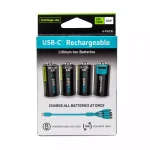
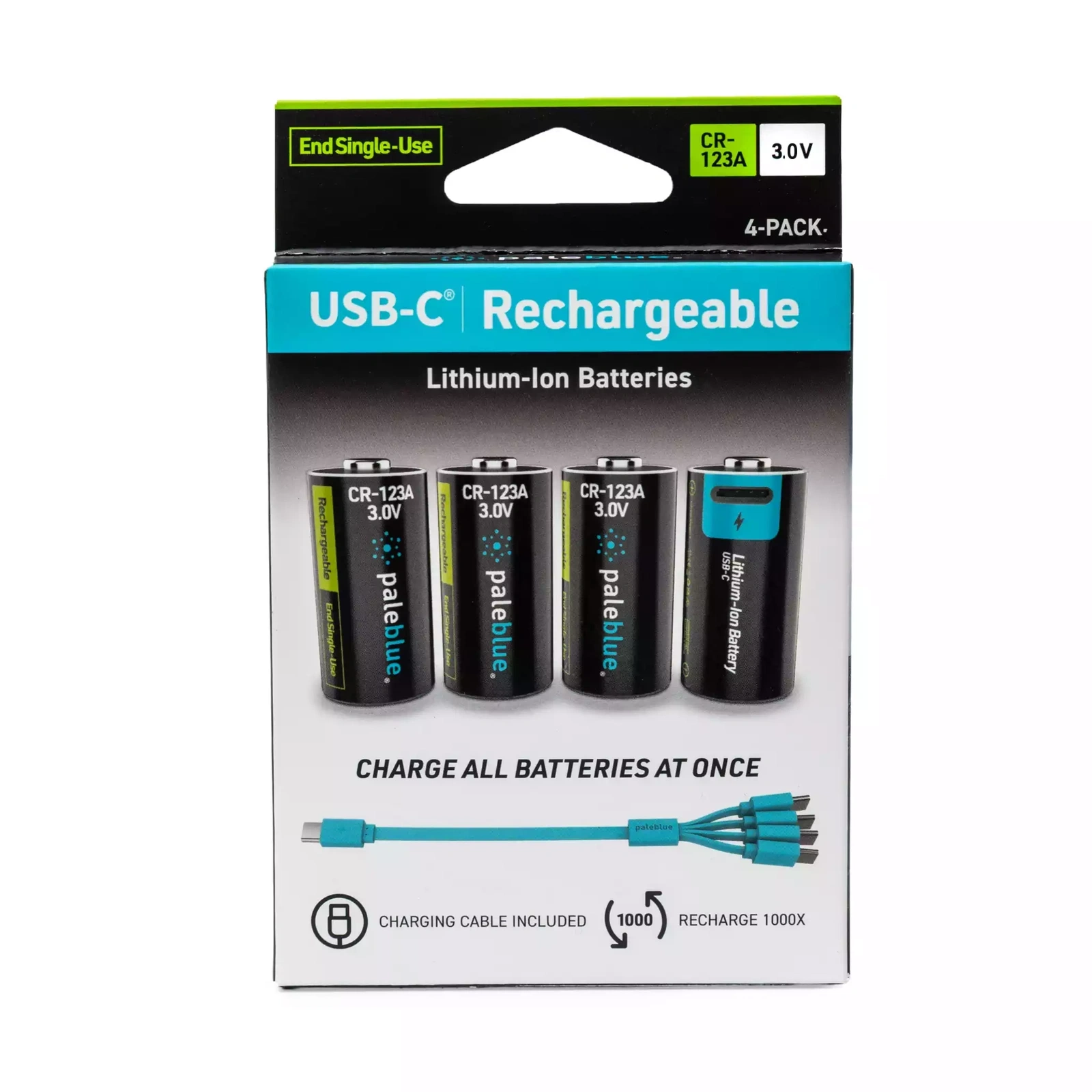
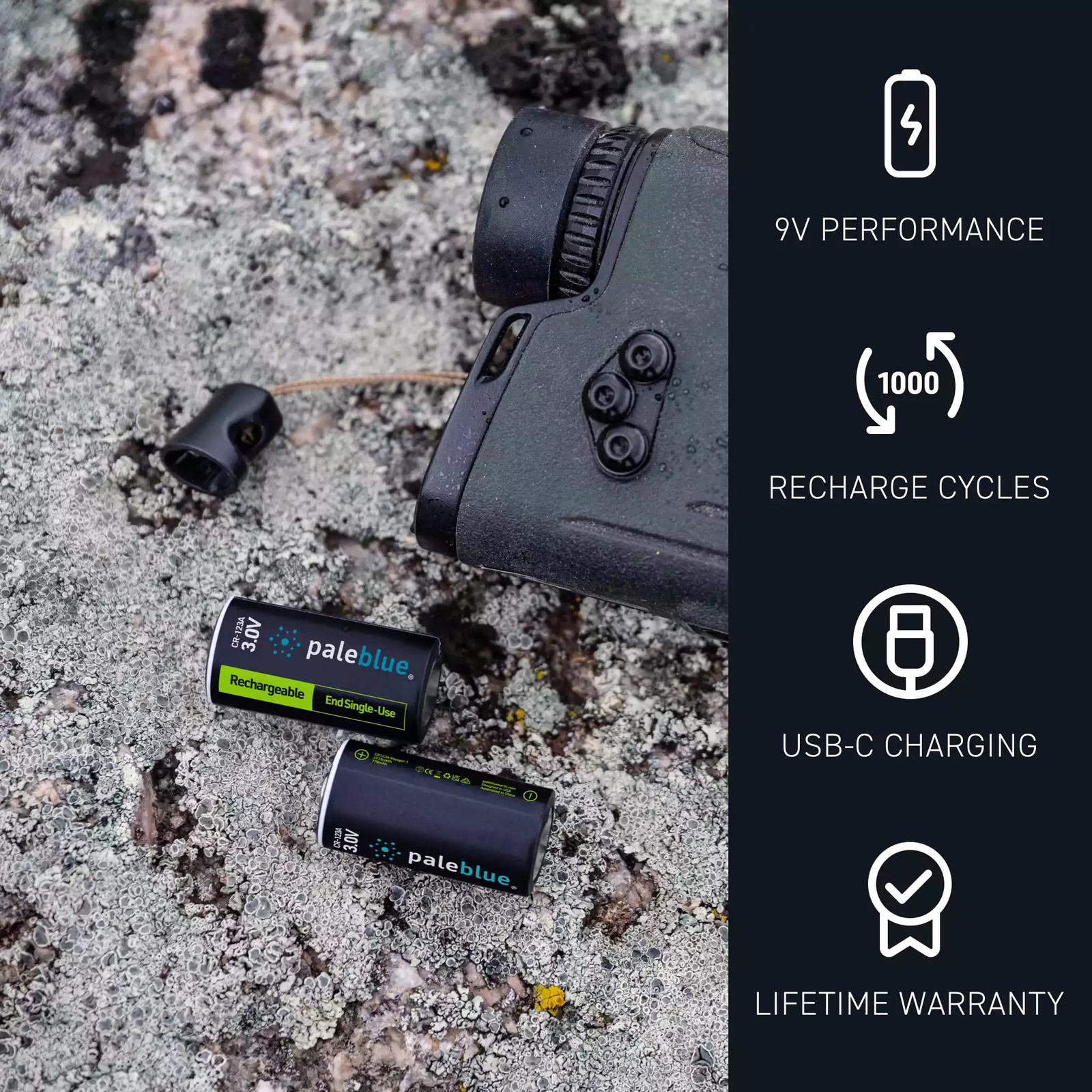
Pack of 4 CR123A rechargeable batteries from PaleBlue Voyager: 3 V, 900 mAh / 2,700 mWh and over 1,000 cycles per battery.
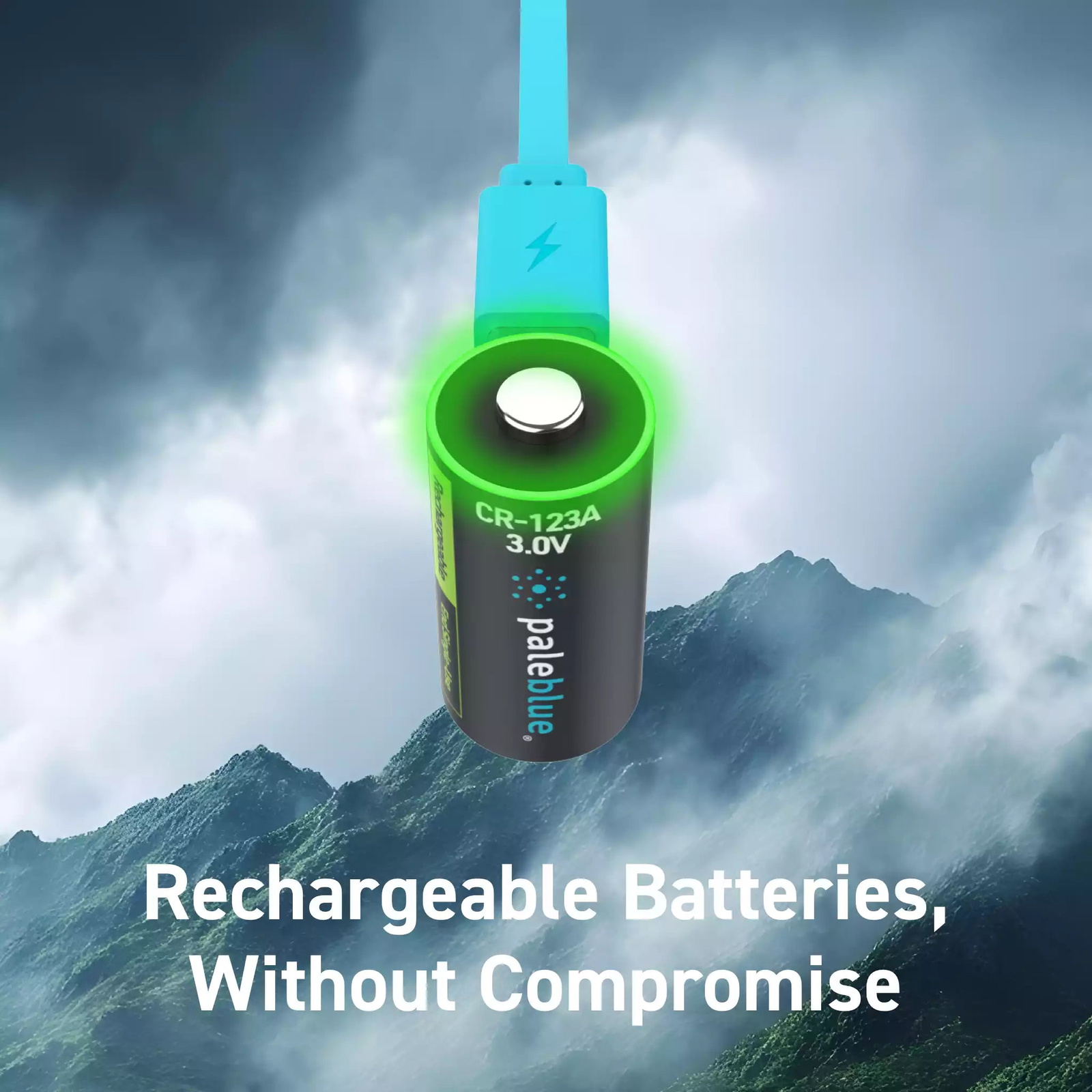
Charge directly via USB-C — works with any charger supporting Power Delivery, a laptop, or a power bank — thanks to the USB-C octopus cable provided, no dedicated charger needed.
Its new discharge curve, modeled on that of a disposable CR123A battery, correctly triggers low-battery warnings: tactical lights, optics, detectors, and alarm sensors finally work normally on rechargeables.
Uses: rifle lights, flashlights and tactical lights, red dot sights, laser modules, and night vision devices — made possible by the regulated voltage of 3.0 V (not 3.7 V like 16340 cells) and by the discharge curve, which triggers the low-battery warning before shutoff.
Available on backorder|In stock at supplier (1–2 weeks)
Pack of 4 CR123A USB-C Rechargeable Batteries — PaleBlue Voyager
At Hexatac, powering our gear is an obsession. We’ve been using rechargeable batteries for years and, for a long time, we were disappointed: wildly overstated runtimes, voltage too low, devices that refused to power on. It was PaleBlue, a French-American brand based in Park City, Utah, that won us back over to rechargeables.
The Voyager series is the second generation of these batteries. It specifically fixes the three complaints people still had about rechargeable lithium batteries: charging, compatibility, and behavior at the end of the charge.
3 New Features of the Voyager Generation
- USB-C Power Delivery charging. The battery now supports USB-C to USB-C charging. It plugs straight into a modern Power Delivery charger, a laptop, or a USB-C power bank, with no USB-A adapter. No more drawer full of dongles.
- All-USB-C octopus cable. The included charging cable ends in multiple USB-C connectors: you charge the whole pack at once, from a single port, with no dedicated charger or bulky cradle.
- A discharge curve that mimics a disposable battery. This is the most important change. Where a conventional rechargeable lithium battery holds a flat voltage and then suddenly collapses without warning, the Voyager’s voltage decreases gradually as its capacity runs down, with a sharp final drop. The result: it is compatible with many more devices, including those with a low-battery warning system.
Why the Discharge Curve Changes Everything
Most devices estimate their battery level by measuring voltage. With a conventional rechargeable lithium battery, that voltage stays flat until the battery dies: the device shows “battery full” and then shuts off abruptly. That is why alarm sensors, smoke detectors, cameras and sighting optics don’t handle rechargeables well — and that’s a deal-breaker on a weapon light or safety equipment, where shutting off without warning is not an option.
The PaleBlue Voyager CR123A reproduces the discharge profile of a disposable CR123A. Your devices get a low-battery warning at the right time — before shutdown, not after.
Use Cases: What Is a Rechargeable CR123A Battery Used For?
The 3 V CR123A format is the standard for demanding gear. Here are the uses where we put these batteries to the test every day.
- Weapon lights. The most common use for the CR123A. The 1.5 A continuous output and 2.7 A peak cover high-output weapon lights, in 1- or 2-battery configurations. Above all, the light no longer shuts off without warning: the beam dims gradually, giving you time to change the battery.
- Handheld and tactical flashlights. EDC lights, high-power flashlights, inspection lights: the Voyager CR123A is a direct replacement for the disposable battery, with a 114-minute USB-C recharge instead of buying new ones.
- Night vision devices (NVGs, monoculars, battery packs). This is where the Voyager generation changes everything — see details below.
- Red dot sights, sighting optics, laser aiming devices, and IR designators. Stable voltage and a reliable low-battery warning, essential on an optic.
- Rangefinders, cameras, alarm sensors, motion detectors, and electronic locks. Devices that used to reject rechargeables work normally.
Night Vision: Why You Need 3.0 V, Not 3.7 V
Most “rechargeable CR123A” batteries on the market are actually 16340 lithium-ion cells, with a nominal voltage of 3.6 to 3.7 V and up to 4.2 V when fully charged. That is too much for a device designed around a disposable CR123A: at best the electronics refuse to start, at worst you damage the power supply of an image intensifier tube.
The PaleBlue Voyager CR123A delivers a voltage regulated at 3.0 V (2.4 – 3.3 V range), right within the power window a night vision device expects. And because its discharge curve mimics that of a disposable CR123A, the device’s low-battery indicator comes on at the right time — before the image goes dark, not after. It is the combination of these two factors, voltage and curve, that finally makes rechargeables usable for night vision.
Since then, that’s all we use.
Cost Savings
A disposable CR123A is expensive and needs replacing often. A Voyager battery pays for itself by the second charge. Over its lifetime, each battery replaces more than 1,000 disposable batteries — an obvious financial gain, and that much less waste.
Technical Specifications
- Manufacturer part number: PB-CR123A-2 (Voyager Series)
- Format: CR123A (ANSI) / CR17345 (IEC)
- Technology: Lithium-ion (NMC613 + LFP)
- Nominal voltage: 3.0 V (2.4 – 3.3 V range)
- Capacity: 900 mAh (measured at 100 mA)
- Energy: 2.7 Wh / 2,700 mWh
- Max. continuous output: 1.5 A (4.50 W)
- Max. peak output (3 s): 2.7 A (8.64 W)
- Charging port: USB-C (USB-C to USB-C input)
- Input voltage: 5 V (4.5 – 6.0 V) — current 100 to 530 mA
- Charging time: 114 min to 100% · 84 min to 80% · 53 min to 50%
- Number of cycles: 1,000+ recharges
- Charge status indicator: LED ring — slow flashing green (charging), solid green (charged), fast flashing red (fault)
- Optimal operating temperature: 10 to 45 °C (50–113 °F)
- Extended operating temperature: -20 to 10 °C and 45 to 60 °C (-4 to 50 °F and 113 to 140 °F)
- Charging temperature: 0 to 60 °C (32–140 °F)
- Dimensions: Ø 16.6 × 34.2 mm
- Unit weight: 15.5 g (± 0.5 g)
- Lithium content: 0.225 g
- Protections: overcurrent, overheating, low temperature, deep discharge, overvoltage, short circuit, leak containment (steel casing with pressure relief vent), short-circuit protection on the cable
- Certifications: IEC 62133, CE, FCC, PSE, UN38.3, RoHS, REACH
- Origin: designed in the USA, assembled in China
Pack Contents
- 4 PaleBlue Voyager CR123A rechargeable batteries
- 1 USB-C octopus charging cable with multiple USB-C outputs
- Carrying cases made of GRS-certified post-consumer recycled plastic
- Recyclable paper packaging
Frequently Asked Questions
Do these rechargeable CR123A batteries work in all devices?
They are designed to replace a standard disposable CR123A battery. Thanks to their 3 V output and new discharge curve, they work in devices where conventional rechargeables failed: tactical flashlights, optics, cameras, alarm sensors, precision instruments. If in doubt, check your device’s instructions.
Do I need a special charger?
No. Each battery has its own built-in USB-C port and charging electronics. The included octopus cable is all you need: plug it into any USB-C source (Power Delivery charger, laptop, power bank, solar panel).
How is it different from the previous PaleBlue generation?
The Voyager moves from a USB-A to USB-C cable to an all-USB-C cable, gains capacity (900 mAh / 2,700 mWh vs. 860 mAh / 2,500 mWh), and above all adopts a disposable-style discharge curve that greatly expands its compatibility.
Can I use them in a tactical flashlight or weapon light?
Yes, it’s one of their main uses. The 1.5 A continuous output and 2.7 A peak cover the vast majority of high-output lights. However, check the voltage range your light accepts, as some models have a maximum voltage.
Can I partially recharge them?
Yes. Lithium-ion chemistry has no memory effect: recharge whenever you want without degrading the battery.
Only logged in customers who have purchased this product may leave a review.
Related Products


A rechargeable battery that pays for itself by the second charge!
In stock|Ships within 1–5 business days
In stock|Ships within 1–5 business days
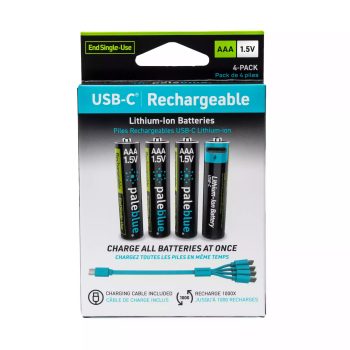
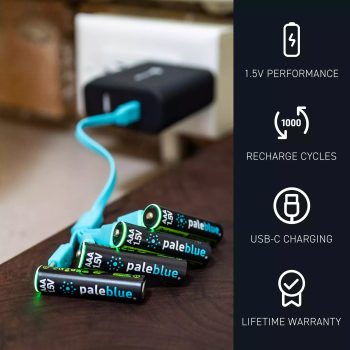
Pack of 4 AAA / LR03 rechargeable batteries from PaleBlue Voyager: 1.5 V actual voltage, 750 mAh and over 1,000 cycles per battery.
Charge directly via USB-C — works with any charger supporting Power Delivery, a laptop, or a power bank — thanks to the USB-C octopus cable provided, no dedicated charger needed.
Its new discharge curve, modeled on that of an alkaline battery, correctly triggers low-battery warnings: headlamps, wireless mics, detectors, and remote controls finally work normally on rechargeables.
Uses: red dot sights (Aimpoint CompM5), headlamps, active hearing protection such as the MSA Sordin Supreme, wireless mics, rangefinders, and small everyday devices.
In stock (can be backordered)|Ships within 1–5 business days
In stock (can be backordered)|Ships within 1–5 business days


A rechargeable battery that pays for itself by the second charge!
In stock|Ships within 1–5 business days
In stock|Ships within 1–5 business days


A rechargeable battery that pays for itself by the second charge!
In stock|Ships within 1–5 business days
In stock|Ships within 1–5 business days
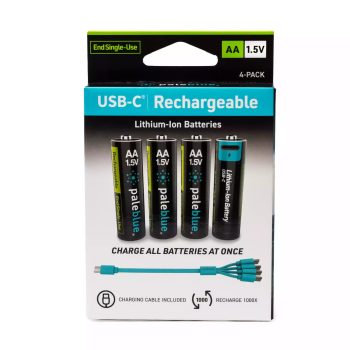
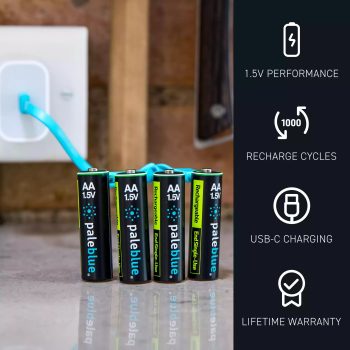
Pack of 4 AA / LR6 rechargeable batteries from PaleBlue Voyager: 1.5 V actual voltage, 2,200 mAh and over 1,000 cycles per battery.
Charge directly via USB-C — works with any charger supporting Power Delivery, a laptop, or a power bank — thanks to the USB-C octopus cable provided, no dedicated charger needed.
Its new discharge curve, modeled on that of an alkaline battery, correctly triggers low-battery warnings: smart locks, detectors, cameras, and measuring instruments finally work normally on rechargeables.
Uses: night vision (Thales BONIE, PVS-14-type monoculars), active hearing protection such as the Peltor ComTac, tactical lights, laser modules, rangefinders, GPS units, and everyday electronics.
In stock (can be backordered)|Ships within 1–5 business days
In stock (can be backordered)|Ships within 1–5 business days
The code that sender entered does not match the CAPTCHA
There are no reviews yet.